The ten looks below run from a $23 drugstore starter kit to pro-only UV pigments, and the one that belongs to you depends on whether you need it to survive a blacklit festival or a bathroom mirror at arm’s length. James Charles’s galaxy sponge technique forgives shaky hands, but three layers of glitter read as mud, not nebula.
1. Galaxy Look

Blues, purples, and blacks sponged together build the nebula base, with fine white dots placed last for stars. James Charles popularized this approach, and the technique itself is forgiving: sponge-blending face paint leaves soft edges that read as cosmic gas rather than stripes. The stardust effect comes from glitter, but it is easy to overdo. My own attempt piled iridescent pigment on top of shimmer on top of glitter, and the result looked muddy under indoor light, not galactic. One layer of glitter, pressed onto the highest point of each blended cloud, reads as depth; three layers read as texture gone wrong. White dots need a steady hand and a fine brush, or they blob into unexpected planets.

Water Based Face Paint: packed with 18 vibrant colors, satisfies most adults makeup, its black and white reach 12.7g as basic foundation, water based face paint, thin, non-greasy, goes on smoothly and show up brightly, paired with face paint brushes makes masterpieces on skin, making your look solid without the fear of smearing.
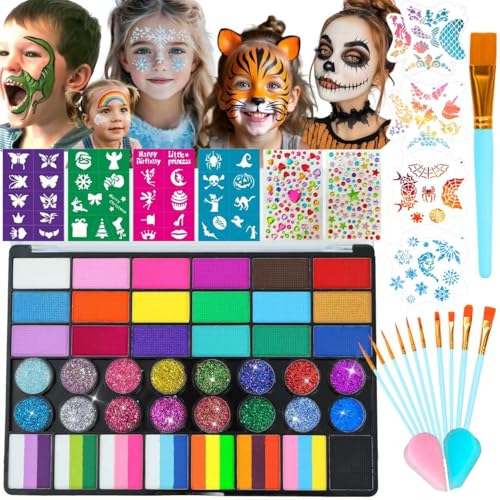
Abundant Colors and Tools: Face painting kit for kids includes 19 single color, 7 split cake colors and 16 glitter colors, match 4pcs stencils, 4pcs tattoos, 2pcs gems, 2pcs sponges, 11pcs brushes, it is professinal face painting kit to DIY at home

2. Optical Illusion Makeup

Optical illusion makeup turns the face into a puzzle that moves when the viewer blinks. The whole point is controlled lying: shading that suggests depth where the skin is flat, lines that claim an edge is folding away. Artists like Mimi Choi build split faces and melting features by treating the cheek as a canvas that curves in two directions at once.
The shading has to be graded so gradually that the transition reads as shadow rather than makeup. I spent my first evening on this convinced I understood the principle from watching tutorials. I laid the darkest tone where I wanted the "hole" to read deepest, then feathered outward. The mistake was placing that darkest point too close to my actual eye socket. In a photo the distortion worked, but in person the natural hollow of my eye swallowed the painted one and the whole jaw-displacement I’d drawn above it looked smudged, not dimensional. The shadow needed to sit at least half an inch higher, on the flat plane of the cheekbone, where no real anatomy would compete with it.
Precision matters more than product. A fine brush and patience do what expensive pigment cannot.

🌈 ULTRA VIBRANT NEON COLOR FOR CREATIVE LOOKS Create bold and eye-catching makeup styles with highly pigmented neon shades. This fine powder delivers intense color payoff for unique eye makeup, face art, and creative designs.

VIBRANT NEON UV GLOW: This water-activated palette features 8 bold neon shades that are vivid by day and glow intensely under UV blacklight. These glow in the dark accessories are perfect for creating high-impact looks that stand out in any dimly lit environment, though please note that blue and purple exhibit a softer fluorescence
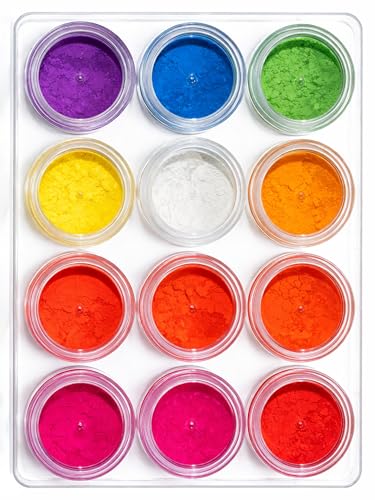
Glow Bold at Every Event From Cosplay to Festival Lights: This makeup pigment powder set includes 12 UV-reactive neon pigments that shine bright in daylight and glow in the dark under blacklight for rave, parties, festival, cheer, cosplay, or Halloween looks
3. Animal-Inspired Designs

Tiger stripes and butterfly wings sit at opposite ends of the same skill curve, and the right starting point depends on how much face real estate you’re willing to surrender. Full tiger coverage demands symmetry across both cheeks and the bridge of the nose; a single gold-and-black wing on one eyelid gives you the motif without the mirror-checking anxiety.
The passage that stuck with me, reading through the beginner guides, was the eyelid-scale entry: a butterfly wing applied only to the lid builds the hand control you’d later need for the full mask, and it reads as artistic rather than costume at an ordinary Saturday dinner.
For the stripe work specifically, brush size is the make-or-break variable. A 2–3 mm angled liner delivers the thin, tapered points that sell the illusion of actual fur patterning; anything wider and the stripes flatten into costume paint. I keep two widths within reach: the slim one for the black base stripe, and an even finer detail brush for the orange hairs you’d lay over it to create depth.
Events like Halloween and cosplay conventions are where these designs peak in popularity, which means the testing window is September, not the night before.
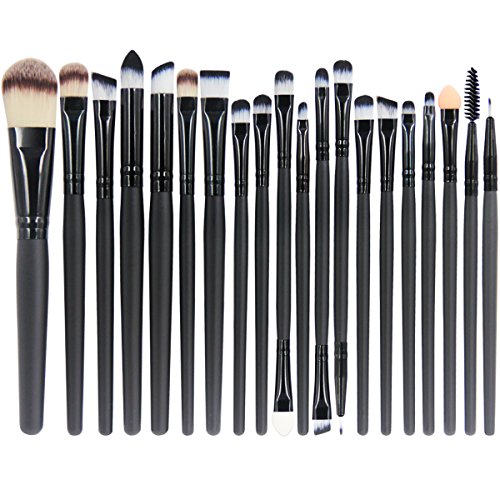
This EmaxDesign cosmetic brush set will show your natural beauty and leave a flawless finish. Handmade brushes made of premium synthetic fiber materials provide an incredible touch and feel

Eye shadow brushes. Making eye color glide onto your eye lids or under eye "smudging" very effortlessly.

Unique Design: This flat foundation brush has ultra thin,soft,dense bristles,which is faster,evenly, without streaks for face makeup.The thickened aluminum tube and electroplate handle makes the makeup spatula brush more durable and suitable for gripping
4. Pop Art Makeup

Pop Art makeup borrows directly from the mid-century movement itself, not just the Instagram filter version of it. Roy Lichtenstein’s Ben-Day dots are the clearest bridge from canvas to face: in his 1964 Crying Girl, those mechanically printed dots create tonal gradation through density rather than shade. On skin, the same effect works two ways. Face paint lets you lay down clean, uniform circles with a brush and steady breath-control, building the illusion of shadow or contour by spacing dots closer or farther apart. Powder demands a different approach, since even highly pigmented formulas blend at the edges; you get a softer, more halftone result that reads as comic book from a distance but loses the sharp edge up close.
Thick black outlines are non-negotiable, the same way Lichtenstein’s inked edges separated color blocks from white canvas. Highly pigmented eyeliner, not standard shadow, carries enough opacity to draw a jawline or eyebrow ridge that photographs as bold as it reads in person. The viral social media versions that made this trend famous tend to over-outline everything at once, which flatters a phone screen better than a real face three feet away. Pick one feature to outline dramatically, leave the rest relatively quiet, and the look holds together under bathroom lighting too.

BOBISUKA face painting kit has 12 highly pigmented colors that can be used directly or mixed with other colors to create as many different colors as you like, including white, brown, beige , orange, black, rose, dark green, blue, red, purple, green and yellow. This kit will meet all your needs!

SAFE AND PROFESSIONAL QUALITY - Suitable for sensitive skin! Our cosmetic grade face paint is 100% non-toxic, hypoallergenic, & paraben-free, which makes it safe for every kid and adult with sensitive skin.

【UCANBE Athena Face & Body Paint | 12 Colors Basic Palette】UCANBE Athena Face Paint Palette(Basic Version)includes 12 essential classic bold shades- ghost white, jet black, vampire red, creepy clown pink, witch purple, pumpkin orange, zombie moss green, neon lime green, bright yellow, werewolf brown, sally blue and navy blue. Designed with EXTRA-LARGE BLACK & WHITE PANS, giving you more of the essential shades that are used frequently for outlines, highlights, shadows, mixing, details and full-face designs.
5. Nature Elements

Not every green stays green once skin chemistry gets involved. The truth is, earthy tones are among the hardest to keep true.
Over two summers I swatched and wore three separate nature-themed palettes to see which formulas oxidized and which held. The cooler olive and sage shades in the first set shifted toward brown within two hours of wear; warm undertones pulled them muddy. A second palette’s forest and moss greens leaned almost teal by midday, which was unpredictable but at least stayed recognizably in the family. The third, an all-mineral line, was the only one where the fern and clay tones stayed exactly the depth they looked in the pan, morning to night.
If you want leaf-inspired shapes that read as nature and not as bruise, test the wear yourself before committing to a full look. Mineral bases cost more per gram but save the redo.

【Oil-based Face Body Paint】A matte cream formula.Waterproof and good coverage.Rotating design, it is soft enough to slide easily, but sturdy enough so you don't have to worry about the color stick falling off.
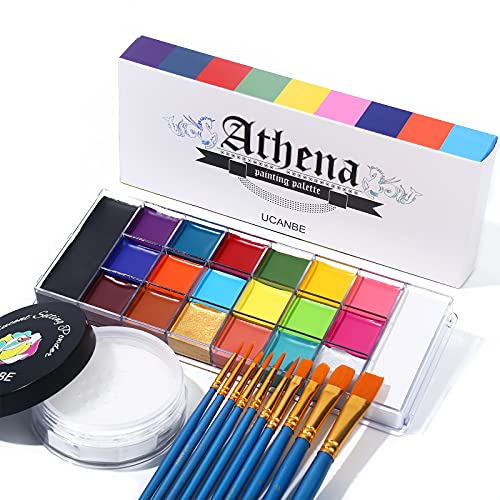
UCANBE Full Makeup Kit - This 3-piece set of oil face and body paint comes with a 20-color palette, a 30-gram box of setting powder and 10 makeup brushes. (The brushes come in the same box as the face paint palette and you have to take the box apart to see the brushes.) Ideal as a gift for your family, friends and yourself to create a fabulous face body makeup look.

🎨 𝗩𝗜𝗕𝗥𝗔𝗡𝗧 𝗖𝗢𝗟𝗢𝗥𝗦 𝗪𝗜𝗧𝗛 𝗘𝗔𝗦𝗬 𝗔𝗣𝗣𝗟𝗜𝗖𝗔𝗧𝗜𝗢𝗡 - Our facepaint crayons glide smoothly on the skin, offering a brilliant and bright palette of colors, ideal for creating various designs with ease. At 3.25" long our waterproof face & body paint crayons are 30% longer than any other brand on the market ensuring durable wear for hours of playful imagination. With enough face makeup to be used for 100+ faces they are perfect for parties and events.
6. Cultural Heritage Makeup

Traditional Aboriginal dot painting and tribal African patterns have been adapted into modern makeup designs, but the line between appreciation and appropriation sits in the research you do before wearing them out. I spent three evenings reading about specific motifs before trying a dotted liner look for a gallery opening, and the difference showed up in conversation: people asked about the meaning behind the placement rather than assuming it was random decoration. The pattern must come from understanding, not from aesthetic grab. A motif that symbolizes water or ancestry in its original context needs that context intact, or the face becomes a costume. My rule now is to trace a design back to its community of origin and check whether that community currently sells or teaches the work themselves. If they do, buying their materials or taking their instruction is the path; if they don’t, the design stays in the reference folder.

🎨 𝗖𝗢𝗠𝗣𝗟𝗘𝗧𝗘 𝗙𝗔𝗖𝗘 𝗣𝗔𝗜𝗡𝗧 𝗞𝗜𝗧: Unleash creativity with 28 vibrant color face painting kit for kids, 24 reusable stencils, 100 gem stickers, 2 body glitter pots, 3 brushes, 4 sponges, & a 16-design booklet & bonus rainbow split cake - fun for the whole family! A fun Halloween face paint kit with stencils and Halloween face paint kit for adults. Please note: Packaging may vary

Face Painting Kit for Kids - 15 Color Large Water Based Makeup Paints with Stencils, 2 Brushes, Halloween Makeup Kit, Safe Professional Body & Face paint Kit

PROFESSIONAL FACE PAINTING KIT INCLUDES:This 4in1face painting kit provides you a complete makeup experience. 20 Water-based pigments intensive pigmented colors in a convenient and sturdy plastic case that applies easily with sponge or 10 sticks brush. Complete your unique and amazing paintings in one time
7. Glow-in-the-Dark Makeup

UV-reactive pigments turn ordinary festival makeup into something else entirely once the blacklight hits, and Coachella is where this look peaked for good reason. The trick is knowing which products actually fluoresce versus just looking neon in daylight. Some drugstore formulas that promise glow-in-the-dark effects contain optical brighteners that wash out completely under blacklight, while pro lines like Kryolan and Mehron’s blacklight series hold a true fluorescent reaction because the pigment suspension is built for UV exposure rather than shelf appeal.
I learned the hard way that price doesn’t always track with safety here. One widely available drugstore liquid liner advertised for glow parties caused noticeable eye irritation within twenty minutes of application, enough that I spent half the night blinking against a contact-lens sensation that outlasted the makeup by hours. The formula list wasn’t unusual, which suggests the concentration or the specific brightener batch mattered as much as the chemistry itself. For anything near the waterline, the pro lines win on both the glow and the wear, and the difference in blacklight performance is not subtle once you’re actually inside the venue.

[Glows ONLY Under UV Light]: The magical color appears ONLY in darkness under a UV black light.

BRIGHT UV REACTIVE NEON COLORS – GLOW UNDER BLACK LIGHT Unleash your creativity with 12 vibrant neon shades that shine brightly under UV and black light. These highly pigmented face and body paint sticks create bold, eye-catching designs that stand out at glow parties, festivals, Halloween, cosplay events, and night celebrations.

Glow In The Black Light Paint: These glow in the dark face paint will glow brightly under ultraviolet light or black light.they will make you shine and dazzling in the dark. But face paint cannot glow in the dark directly.
8. Fantasy Characters

Instagram SFX tutorials make mythical creature makeup look effortless from six inches away, but the jump to arm’s length is where most looks fall apart. What convinced me, reading through a dozen of these breakdowns, is that the boundary line matters more than the pigment. That crisp edge where skin meets prosthetic is what reads as "real" from a conversation distance.
Humidity is the killer. Standard lash glue turns to a gummy edge in summer air, and spirit gum needs solvent that most people do not keep in their bag. Medical-grade silicone adhesive holds through heat and sweat, though it needs fifteen minutes undisturbed to cure fully. Pressing a prosthetic down before that window closes traps a pocket of moisture underneath, and the whole piece lifts by hour two.
Paint choice splits the same way. Skin-safe alcohol paints flex with facial movement and do not crack at expression lines, where water-activated cakes dry to a finish that looks like dried mud when you smile. The tradeoff is rubbing alcohol for removal, which stings on sensitive areas. I would skip liquid latex for anything near the eyes entirely; the flaking is invisible in a phone video, obvious in person.
Start small. One horn tip or an ear extension teaches you more about timing and adhesion than a full-face silicone mask ever could.
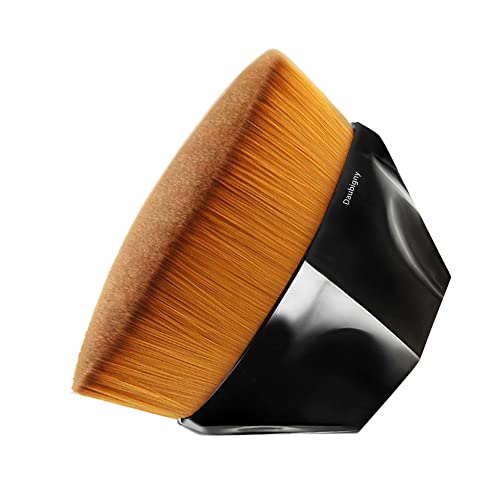
Dense, Firm, and Soft Bristles: This is by far the best foundation brush which is very soft to touch and apply foundation on your face,skin-friendly,It does not absorb and waste products and applies foundation smoothly and evenly.

★【Premium Synthetic Hair】▬ Non-irritating,Soft and Smooth,High Density,Skin Friendly, Streak Free for Makeup on Any Skin Type,Full Coverage Liquid, Cream, Wet Cosmetics.

Eyeshadow Brush: Blend eyeshadows effortlessly with the NYX Professional Makeup Pro Blending Brush; Long rounded two tone vegan bristles are super soft and flexible, making it ideal for blending eyeshadows of all textures and finishes
9. Minimalist Abstract Art

Sharp triangles, dots, or zigzag lines placed asymmetrically on the face can carry a whole look without the weight of a full graphic design. I learned this the hard way after spending twenty minutes building a symmetrical grid across both cheeks, only to watch it compete with itself in every photo. A single off-center line, drawn clean with a small ruler, held the eye longer and took under two minutes. The ruler now lives in my kit because freehand wobbles show instantly at this scale. Beginners gravitate toward this style for exactly that reason: one bold shape is easier to control than a composition, and the mistake is simpler to wipe and redraw.

🌈 𝟭𝟮 𝗧𝘄𝗶𝘀𝘁𝗮𝗯𝗹𝗲 𝗝𝘂𝗺𝗯𝗼 𝗖𝗿𝗮𝘆𝗼𝗻𝘀: The Blue Squid face paint crayons are twistable, water-based, and non-toxic, providing a safe and fun way to create vibrant designs on the face, body, and hair. Our crayons are 2x larger (5.5”) than the size of similar products and includes 12 vibrant colors—Black, Dark Blue, Light Blue, Gold, Green, Orange, Pink, Purple, Red, Silver, White and Yellow—sufficient for painting 80+ faces, perfect for any creative activities.


SAFE AND PROFESSIONAL QUALITY – Suitable for sensitive skin! Meticulously formulated to be 100% non-toxic, hypoallergenic, and paraben-free, our cosmetic-grade face paint is safe and comfortable for all, including those with sensitive skin
10. Emotive Art

Painting a cracked face with shadowed hollows under the eyes takes roughly ninety minutes, and the first time I tried it I stopped at the jawline, which made the whole thing look like a mask sliding off. Extending the cracks down the neck and onto the collarbone fixes that; the break reads as structural, not cosmetic.
The look I wore to a gallery opening last spring went the other direction entirely. Watercolor pigments in muted blues and grays, tears drawn with a fine liner brush so they caught the track lighting. Three people asked if I was okay. One woman stood in front of me for a full minute, then said her sister had died six months earlier and she had not cried yet. The face becomes a permission slip that the viewer did not know they were waiting for.
Dominique Bossavy’s anxiety designs, with their cracked porcelain and pooled shadows, work the same channel. The artist releases something in the making; the viewer meets something in the seeing. Whether the emotion painted is grief or something Bossavy would map as depression, the transaction is the same. The makeup does not perform the feeling so much as host it, for whoever needs the mirror.
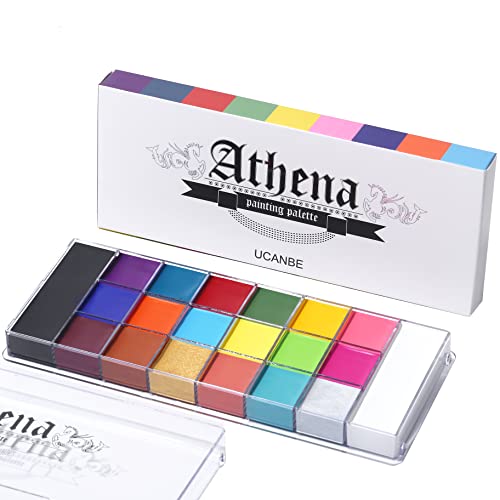
A LARGE SIZE Face Body Paint makeup palette refilled 20 creamy intensive pigmented colors in a convenient and sturdy plastic case that applies easily with sponge or brush. It worked on the face and body such flawlessly and easy to mix and layer.

Vibrant Palette: Our face paint palette features a brilliant range of 15 colors, including primary shades of red, orange, yellow, green, blue, and purple, as well as versatile neutrals like gray, white, black, and brown. To complete the spectrum, we've also added a beautiful pink.

🎨 𝗩𝗜𝗕𝗥𝗔𝗡𝗧 𝗖𝗢𝗟𝗢𝗥𝗦 𝗪𝗜𝗧𝗛 𝗘𝗔𝗦𝗬 𝗔𝗣𝗣𝗟𝗜𝗖𝗔𝗧𝗜𝗢𝗡 - Our facepaint crayons glide smoothly on the skin, offering a brilliant and bright palette of colors, ideal for creating various designs with ease. At 3.25" long our waterproof face & body paint crayons are 30% longer than any other brand on the market ensuring durable wear for hours of playful imagination. With enough face makeup to be used for 100+ faces they are perfect for parties and events.
Face Chart Art

Printed face outlines let you test full looks without booking a face, and the 290-page weight of The Facechart Book Master Edition gives you room to actually learn rather than guess. Liza Kondrevich built it as a professional textbook: tools and materials, color theory written for pigment on skin, how light falls across underlying bone, and technique broken down by feature. Face charting taught me light and shadow before I ever touched a face. The book returns to your desk as your skills change, not the kind you shelve after one weekend.
Makeup Inspired by Famous Art

Some paintings transfer to skin better than others. Van Gogh’s "Starry Night" collapses on mobile cheeks; the swirling sky needs a still, flat plane like the forehead or a closed lid, and even then the thick impasto texture reads as muddy without the actual paint ridges. A few artists have solved this by shrinking the composition to one eye, letting the cobalt and gold orbit the brow bone while the surrounding skin stays neutral.
Vanessa Davis, who works under the name "The Skulltress," proved in 2021 that skull-themed face art could go genuinely viral. Her success came partly from choosing a subject where bone structure already maps to anatomy: hollow temples, prominent cheekbones, the orbital ridge. The Skulltress’s designs train on what your face already has.
Dali’s melting clocks demand soft blending that reads as amateur work in the wrong light; the surrealist blur rewards a face with strong bone definition and punishes rounder shapes. Pop art is the opposite refuge. Thick black outlines, flat color fields, and Ben-Day dots forgive uneven skin and read clearly from a phone screen. Highly pigmented eyeliner and patience matter more than bone structure here. The dot pattern, in particular, hides texture irregularities that softer styles expose.
Starting Without Training

Creative makeup as an art form has almost no gate left standing. Three supplies from the local drugstore were enough to start: a white cream base, a small set of flat synthetic brushes, and a pack of colored pencils meant for the face. The total came to $23, and that was the entire investment for the first six months.
Professional training absolutely helps with skin anatomy, sanitation, and the speed needed for client work. For personal experimentation, though, the skills build through repetition and the willingness to wash off a failed attempt and start again. The gap between a classically trained artist and a self-taught one narrows fast when both are working only on their own face, for their own camera, with no client brief to satisfy.
Frequently Asked Questions
What are some creative makeup ideas?
Galaxy looks, optical illusions, animal-inspired designs, pop art, nature elements, cultural heritage patterns, glow-in-the-dark effects, fantasy characters, minimalist abstract shapes, and emotive art are all covered in the article. Each style demands specific techniques: sponge-blending for nebula bases, graded shading for 3D illusions, or fine dot placement for Pop Art Ben-Day effects.
How can I start with creative makeup?
A white cream base, flat synthetic brushes, and face-safe colored pencils cost about $23 and carry you through six months of experimentation. Begin with simple motifs like a butterfly wing on one eyelid or a single off-center line; these build hand control without the pressure of full-face symmetry. Professional training helps for client work, but personal skills grow through repetition and the willingness to wash off failures.
What is face chart art?
Face chart art uses printed facial outlines to test makeup designs without a live model or wasted product. Artists apply pigment to these templates to plan professional looks, explore risky color combinations, or develop a personal aesthetic through repetition. The Facechart Book Master Edition by Liza Kondrevich is a 290-page professional resource covering tools, color theory for skin, and how light falls across bone structure.